
Publication · 6 settembre 2026 · 8 min Lesezeit
Five Myths About VR Training - and What the Deployment Data Actually Says
Too expensive, too complex, older staff will not take part: five objections to VR training checked against data from live deployments. With sources on cost, usability an
Von SkillCamp Redaktion
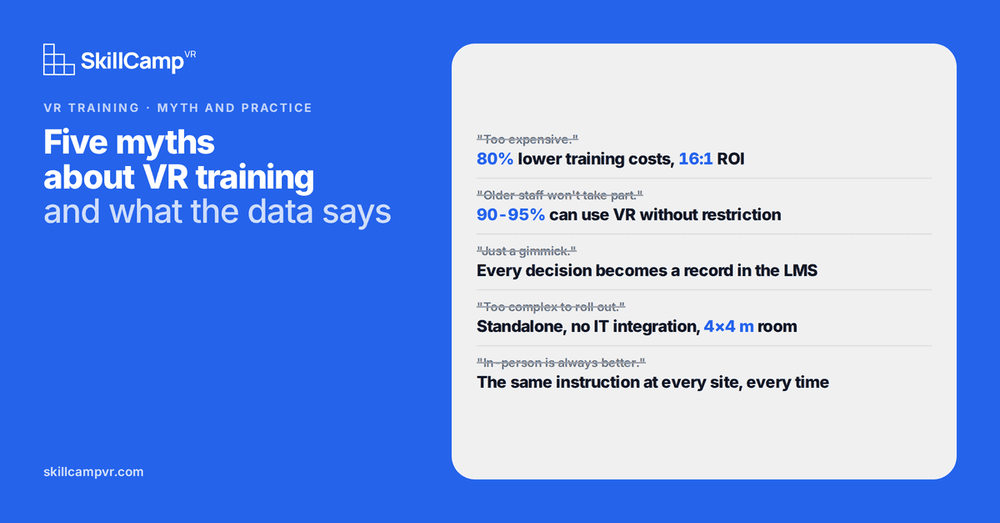
Five myths about VR training - and what the data says
Five objections come up in almost every first conversation about VR training for frontline teams. All five were reasonable at some point, and one of them still is. This is what each looks like against how the technology is actually deployed in 2026.
We have had this conversation a few hundred times now: with heads of training at security providers, with HSSE managers at airports, with operations directors who have to keep a roster covered while people sit in a classroom. The same five objections come up, in roughly the same order.
None of them is unreasonable. The first generation of VR training was expensive to buy, needed its own IT project at every site, and delivered an experience rather than a record. Anyone who was burned by that is applying a lesson, not a prejudice.
What follows is each objection set against what the technology and the deployments look like today, including the one place where the sceptics are still right.
Myth 1: "Too expensive"
The headset is almost never the cost that matters.
The expensive part of conventional instruction is roster time. A day of classroom training is a day of shift coverage bought elsewhere, a trainer who is themselves in short supply, and travel for people who are spread across sites. That cost is real, recurring, and rarely sits in the training budget, which is why it tends to escape the comparison entirely.
Set against that, the published figures are about structure rather than discount. Securitas Deutschland reported an approximately 80% reduction in training costs following its VR deployment, and a 16:1 annualised platform ROI (BDSW DSD Journal 3/2024). Those numbers come from a deployment now running across more than 30 locations with 900+ officers training weekly.
The more useful question in a first conversation is not what a headset costs. It is what one trained, documented employee costs per year today, and what share of that is roster time rather than instruction.
There is a second reason this objection is stubborn. Training sits in one budget line and the consequences of an error sit in another. As long as those two lines are owned by different people, VR reads as a training expense rather than what it usually is in practice: a risk measure with a training delivery mechanism attached.
Myth 2: "Older employees won't take part"
This one is worth separating into two claims, because only one of them survives contact with the data.
The first claim is that a meaningful share of the workforce cannot physically use VR. That is true, and we say so: roughly 90 to 95% of employees can use VR training without restriction. The remaining 5 to 10%, in most cases people with epilepsy or severe motion sickness, need an alternative. Seated VR covers part of that group and a desktop version of the same scenario covers the rest. Any rollout plan that does not name this share before it starts will discover it during week one.
The second claim, that older employees in particular will refuse, does not hold up in the same way. Two things changed underneath it. Standalone headsets removed the cables, the external sensors and most of the motion sickness that made early VR genuinely unpleasant (Securitas case study, 2024). And session design changed: 15 minutes on site, between shifts, in a room of about four by four metres, with no internet connection required during the session. That is a different proposition from an hour in a headset in a room somewhere else.
Willingness, where it has been measured, tends to run ahead of the assumption. In a Bundeswehr survey, 97% of soldiers said they wanted XR systems used in their training.
Myth 3: "It's just a gimmick"
The test for this is simple: what does the system produce after someone takes the headset off?
If the answer is "an impression", the objection is correct. If the answer is a per-person record of which decisions were made, where hesitation occurred, which competence level was reached and when the refresher is due, then it is a measurement instrument that happens to use a headset. Every decision inside a scenario is scored and written to the LMS, which produces automated real-time reports, certificates and audit trails, GDPR-compliant and available on demand.
That record is also the uncomfortable part, and it is the reason some organisations hesitate rather than the reason they buy. Assessment in a realistic scenario surfaces gaps that a paper certificate conceals. In January 2026, 92% of aviation security personnel at Düsseldorf Airport failed the new EU recertification examinations (luftsicherheit-nrw.de). Those were certified people. The certificates were not wrong about what had been completed; they were simply never evidence of what could be executed under pressure.
A gimmick does not produce findings an operator would rather not have seen.
Myth 4: "Too complicated to roll out"
This objection is a memory of a real problem, and the architecture that caused it is gone.
Current headsets are standalone. There is no PC, no cabling, no external tracking hardware and, importantly, no integration with the site's IT infrastructure. In aviation deployments this has been the deciding factor more than once: the training sets run without touching airport systems at all. What a location needs is a room of roughly four by four metres and someone to own the hardware.
Content is the other half of the answer. More than 60 ready-made scenarios exist in the library, which means most organisations start with material that already matches their sector rather than commissioning anything. Site-specific scenarios, built around a particular vehicle, layout or procedure, are a separate step with a separate cost and timeline, and should be planned as such rather than assumed into the first phase.
At the scale this now runs, the rollout question has largely been answered in practice: 60+ active locations, more than 2,000 training sessions a week, and 8 of the 10 largest German security providers on the platform.
Myth 5: "In-person training is always better"
Better at what is the question that makes this productive.
For explanation, for discussion, for the judgement calls that come out of a genuine conversation with an experienced trainer, in-person instruction is not in competition with anything we build. That part should stay.
What the classroom cannot do is deliver the same content at every site, every time, in the same quality. Inconsistency across locations is the failure mode operators describe most often, and it is structural rather than anyone's fault: different trainers, different days, different levels of attention in the room. Standardised content driven from a central LMS is the part that fixes it.
The classroom also cannot rehearse rare, high-consequence events. Intrusion, sabotage, a drone sighting, an evacuation, an aircraft de-icing procedure in weather nobody can schedule: these are exactly the events a competence record is about, and exactly the ones that cannot be staged in live operations. At the Frankfurt hub, 450+ operators have trained across two de-icing seasons, with scenarios covering 73 Vestergaard Elephant Beta units, on equipment that is otherwise in service.
On speed, the most frequently cited enterprise study remains PwC's, which found VR learners completed training up to four times faster than in classroom format and felt up to 275% more confident applying what they had learned. That study examined soft-skills training among PwC's own junior managers, so the mechanism transfers more readily than the precise multiple does. The mechanism is the relevant part: continuous time on task, and repetition of the specific thing being assessed.
Where the sceptics are still right
Three things in this article are limits rather than features, and a plan that ignores them will meet them anyway.
**Five to ten per cent of your workforce will need a different format. **Decide what that format is before the first headset arrives, not after someone has a bad first session in front of their colleagues.
It does not replace your trainers. What it removes is repetition: the same instruction, the same content, at five sites, every year. What that frees is the time for the part a person does better than a scenario.
Someone has to own the hardware. "We have nobody to look after it" is the one objection on this list we consider fully legitimate. It is answerable, but the answer depends on how many sites are involved, and it is an operational question rather than a technical one.
Where to start
Not with a headset, and not with a budget.
Start by listing which roles carry the consequences if something is done wrong, and what evidence you currently hold that those specific people can execute the specific procedure. In most organisations that evidence is a completion date. The gap between a completion date and a demonstrated competence is the entire subject of this article, and it is visible without buying anything.
SkillCampVR provides managed VR and AI-supported training for frontline and operational workforces in aviation security, ground handling and de-icing, security services, work safety, public transport and heavy industry. 60+ active locations, 2,000+ training sessions per week.
Weitere Artikel
The ROI of VR training: where the money actually comes from
The headset is rarely the cost that matters. Where VR training pays back in practice: shift cover, trainer time, travel, error risk and audit records. With the Securitas figures, an example calculation and the five numbers to collect for your own.
20 settembre 2026 · SkillCamp Redaktion
Leggi di più →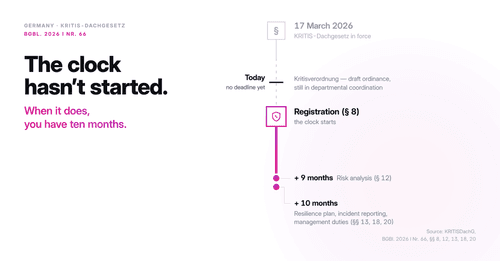
The KRITIS-Dachgesetz: The Personnel Measures Almost Nobody Is Planning For — and Why the Delay Is an Opportunity
The KRITIS-Dachgesetz has been in effect since March 17, 2026, but the ordinance defining critical facilities is still a draft. Registration isn't mandatory yet. Operators should use this valuable planning window now. Once the deadline starts, securing people—not fences—will be the hardest task.
9 agosto 2026 · SkillCamp Redaktion
Leggi di più →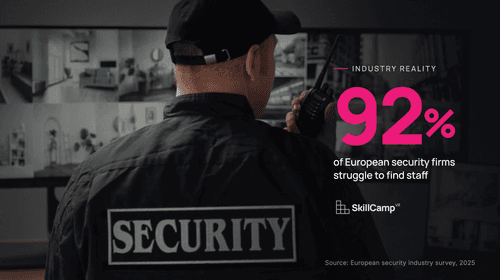
Europe's Private Security Skills Shortage: What the Data Says — and How Training Technology Is Responding
Europe’s private security sector employs around 2 million people and generates over €40 billion a year, yet 92% of firms struggle to recruit. The shortage is structural, not cyclical. This piece explores the data and why training technology is becoming one of the industry’s few practical levers.
27 luglio 2026 · SkillCamp Redaktion
Leggi di più →Bereit, VR-Training in Ihrem Unternehmen einzusetzen?
Sprechen Sie mit unseren Experten und erfahren Sie, wie SkillCampVR Ihre Schulungen transformieren kann.