
Events · October 5, 2026 · 6 min Lesezeit
SkillCampVR at the BDL Abend der Luftfahrt 2026 in Berlin
At the German Aviation Association's Abend der Luftfahrt in Berlin, guests at the SkillCampVR station stepped into the security lane, the Aviathek and the basket of a de-icing truck. Why training capacity is a location factor and how the training works in daily operations.
Von SkillCamp Redaktion

SkillCampVR at the BDL Abend der Luftfahrt 2026 in Berlin
On 6 October 2026, the German Aviation Association (BDL - Bundesverband der Deutschen Luftverkehrswirtschaft) hosted its Abend der Luftfahrt at the Bolle Festsäle in Berlin. SkillCampVR took part with a VR station. For a few minutes, guests could step into the security lane, the Aviathek and the basket of a de-icing truck themselves.
For our team it was a special evening. The people who decide on cost, competitiveness and safety in air transport experienced for themselves what training in aviation can look like today.
The Abend der Luftfahrt The Abend der Luftfahrt is the BDL's annual evening event in Berlin. It brings together airlines, airports, air navigation services, the aviation industry and politics, during a sitting week of the Bundestag, with around 600 guests. The association represents the German air transport industry towards politics and the public; on this evening its members meet members of parliament, ministries and partners from the industry.
BDL member companies were present with stations of their own. We were invited as a partner with a station: no presentation, no talk, but something to touch.
What guests experienced at our station Four headsets, three scenes, a few minutes per person. Our CEO Pavel Druzhkov and our team were there for the whole evening.
The security lane. Guests stood on the other side of the security checkpoint, as a screener: bags onto the belt, liquids and electronics out, decide what goes through and what does not. Anyone who usually only passes through as a passenger suddenly sees the lane with different eyes.
The Aviathek. An item in the hand, turn it, look at it, and then the X-ray image of it. Allowed, restricted or prohibited? This is how aviation security staff learn to recognise items in an X-ray image before they sit at the real monitor.
De-icing. In the open basket above the wing, with the task of getting the surface ice-free within the given time. A situation that cannot be practised on a real aircraft as often as you like, but in VR as often as needed.
All scenes run standing up and without artificial movement. The headset can be taken off at any time, and it works over glasses.
Training capacity is a location factor A lot of new technology is arriving at airports right now: CT scanners, new rules for liquids, biometric processing. The technology is not the bottleneck. It is the people who operate it.
Staff turnover is high all year round. Seasonal peaks require many employees to become operational at the same time. Networks of hubs, outstations and pools are expected to hold the same standard everywhere. And every new hire has to reach a safe standard before the first shift begins.
Training capacity thus becomes the limiting factor of the operation. Every week until a new hire can work independently, and every trainer hour, ends up in the price of a security check, a de-icing, a turnaround. That was our thought for this evening: qualification is an underestimated lever for cost and reliability in air transport.
Three things change when training is prepared digitally:
- Onboarding and peaks. Classic onboarding ties up one experienced employee per new hire. Digitally prepared qualification relieves exactly that point: operational sooner, without additional trainer capacity, without travel to small stations.
- One network, one standard. Across distributed sites, training quality today depends on individual trainers and local calendars. A centrally maintained system keeps the standard constant, at the outstation as at the hub.
- Evidence instead of attendance. The yardstick shifts from documented participation to demonstrated performance: analysable training records per person, role and site, available when someone asks for them.
One system, every site, the same standard What guests in Berlin saw in the headset is one part of it. The whole system has four building blocks:
- VR training, the practice. Critical and rare situations are rehearsed before they occur in operations.
- Learning portal for desktop, tablet and mobile, the theory. Reaches every employee, even without hardware and without a classroom date.
- AI assistant, the companion. Answers questions during training and on shift, from a verified, closed knowledge base of the customer.
- LMS, the bracket. Plans, assigns, measures and documents. This is where the evidence is created.
One provider, one contract, one continuous record. The training runs at the customer, delivered by the customer's own people; we supply the software, the content and the equipment.
The training does not replace instruction, it complements it. Practice on real equipment stays, and manual searches continue to be practised live. VR takes over preparation and repetition, as often as needed, the same at every site.
In daily operation This is not a pilot. For two years, several thousand aviation security staff have been trained with our system at seven German commercial airports. Across all industries, around 2,000 VR training sessions run per week at around 60 sites. The German Federal Police (Bundespolizei) assesses the approach as a suitable training instrument.
At Frankfurt Airport, de-icing teams have been training in VR for two winters, more than 450 operators, with their own fleet rebuilt in the simulation.
SkillCampVR is a member of the BDLS and the BDSW.
For orientation, from independent VR research (including PwC 2020), not results measured by SkillCampVR: learning up to four times faster and with better retention, up to 80 percent less training time, up to 40 percent fewer errors.
Thank you Our thanks go to the BDL for the invitation, and to **Carola Scheffler and her team ** for organising an evening that brings the industry together. Thank you also to every guest who put on a headset and asked us their questions. We look forward to continuing the conversations that started in Berlin.
See it for yourself Organisations that want to see the training in practice can arrange with us:
- A demonstration at their own site, with headsets and their own staff.
- A reference visit to a live training site, for example at Frankfurt Airport.
- A working session with the people responsible for training, security or ground operations.
Weitere Artikel
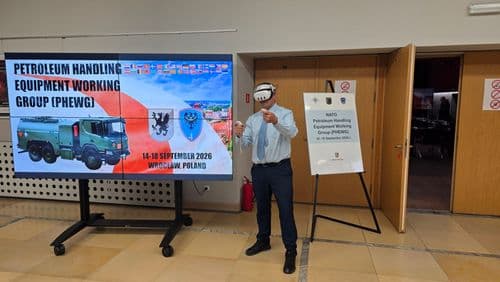
SkillCampVR at the NATO Petroleum Handling Equipment Working Group industry session in Wrocław
At the NATO Petroleum Handling Equipment Working Group meeting in Wrocław, SkillCampVR and UPLIFT INTERNATIONAL presented VR training for military fuel handling: the whole fuel chain, emergencies that cannot be practised live, and a record of competence.
October 12, 2026 · SkillCamp Redaktion
Read more →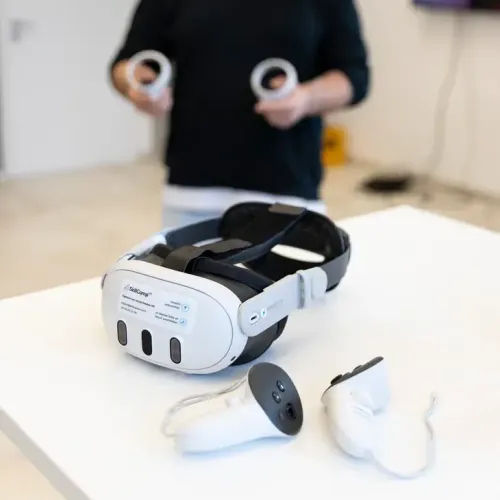
Innovative VR Training Solutions at Stölting Service Group
We demonstrated at Stölting Service Group how customized VR training solutions make the learning process more efficient and motivating.
November 26, 2025 ·
Read more →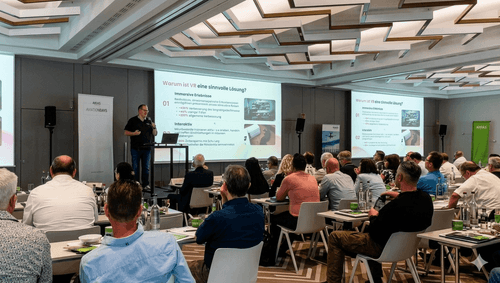
AWiAS Aviation Days 2025 in Hamburg – Virtual Reality Training für die Luftsicherheit im Fokus
Bei den AWiAS Aviation Days 2025 in Hamburg präsentierte SkillCampVR, wie VR das Training in der Luftsicherheit effizienter und zukunftsfähig macht.
June 18, 2025 · SkillCamp Redaktion
Read more →Bereit, VR-Training in Ihrem Unternehmen einzusetzen?
Sprechen Sie mit unseren Experten und erfahren Sie, wie SkillCampVR Ihre Schulungen transformieren kann.