
Publication · 20 septembre 2026 · 7 min Lesezeit
The ROI of VR training: where the money actually comes from
The headset is rarely the cost that matters. Where VR training pays back in practice: shift cover, trainer time, travel, error risk and audit records. With the Securitas figures, an example calculation and the five numbers to collect for your own.
Von SkillCamp Redaktion
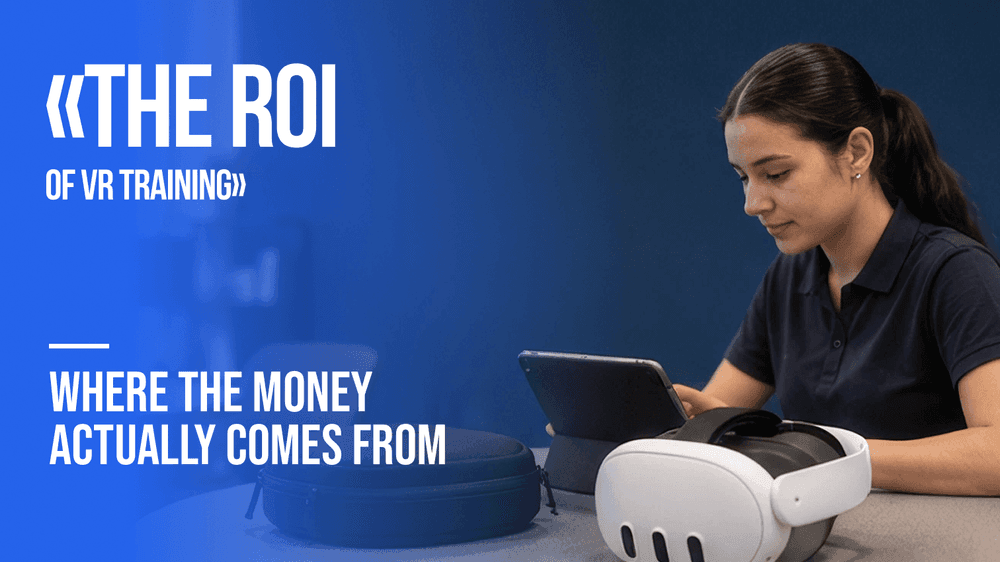
The ROI of VR training: where the money actually comes from
Most ROI discussions about VR training start with the price of the headset. That is the wrong end. The return sits in the costs a classroom creates around the training itself, and in what a documented competence is worth when something goes wrong.
Ask a head of training what annual refresher training costs and you will usually hear the trainer budget. Ask an operations manager and you get a different, larger number: the shifts that had to be covered, the overtime, the people who drove two hours to a training centre, the session that had to be repeated because half the group was ill or needed elsewhere.
Both answers are correct. They simply sit in different budget lines, and that is the main reason ROI calculations for VR training tend to come out either far too optimistic or never get done at all. This article goes through where the return actually comes from, what has been measured in live deployments, and how to put together a calculation with your own numbers.
Where the cost of classroom training really sits
The instruction itself is rarely the expensive part. What costs money is getting people out of operations and into a room.
The trade journal DSD (3/2024) described a situation familiar to anyone who runs security sites: weeks of planning to release 12 people for fire safety training, replacements organised because staffing is thin, and then on the day four people call in sick and three more are needed at another site. A second date has to be found to stay compliant. Extra effort, extra cost, and nobody has learned anything yet.
That cost has four parts:
- Shift cover. Every hour in a classroom is an hour someone else works, often at overtime rates.
- Trainer time. The same content delivered again and again, group by group, site by site, by people who are themselves in short supply.
- Travel. Time and mileage for staff spread across locations.
- Organisation. Scheduling, rescheduling and chasing attendance, mostly done by site managers who have other jobs to do.
None of this appears on a quote for headsets. Comparing a headset quote with the trainer budget therefore misses most of the picture.
What happens in practice
The best-documented example is Securitas Deutschland, described in the trade journal DSD (3/2024).
The mechanism is simple. Each site received a standalone headset. Employees complete one or two micro-units of about 20 minutes per week, whenever operations allow, and every result flows into the group-wide learning management system. Because clients allow training during idle periods, the costs of shift cover, trainer fees and travel largely fall away. The deployment now covers more than 30 Securitas locations, with 900+ employees training every week.
Note what did not happen: the amount of practice did not go down. One or two units a week add up to more hands-on repetition over a year than a single classroom day, and the record of it is far more detailed.
Aviation shows a second kind of return. At Frankfurt Airport, 450+ de-icing operators at NICE Aircraft Services have trained in VR across two de-icing seasons. De-icing is a textbook case of training that is expensive to stage for real: the vehicles are in service, the fluid costs money, and the weather the procedures are written for cannot be scheduled. In VR, the procedure can be practised in October for the conditions of January, without taking a vehicle out of operation.
Independent research points the same way: people learn faster and retain more when they actively practise a procedure than when they listen to someone explain it. Continuous active time on task is the mechanism, and it is the same one at work in the examples above.
The return that does not show up in the training budget
Cost savings are the easiest part to calculate. For many operators they are not the largest part.
Errors and failed examinations. A competence rehearsed in a realistic scenario is different from a certificate saying a course was completed. In January 2026, 92% of aviation security staff at Düsseldorf Airport failed the new EU recertification examinations (luftsicherheit-nrw.de). Every failed exam means retraining, retesting, and people who cannot be rostered in the meantime.
Rare events with serious consequences. An evacuation, an intruder, a fire in an escape route, de-icing in freezing rain. These events decide what an incident costs, and they are exactly the ones that cannot be practised in live operations. One prevented incident often outweighs a programme's annual cost, but it is fair to call that an avoided risk rather than a saving you will see on a statement.
Records. Every decision inside a scenario is scored and written to the LMS: who trained what, when, at which level, and when the refresher is due. That record is what auditors, insurers and clients in tenders increasingly ask for. Its value shows up as contracts kept and audits passed, not as a line in the training budget.
How to build the calculation
Take your own figures for a typical year and add up four lines.
| What to count | How to calculate it |
|---|---|
| Shift cover | Hours spent in training × cost of one hour of cover, including overtime premiums |
| Trainer | Training days per year × internal or external day rate |
| Travel | Travel time × hourly cost, plus mileage |
| Organisation | Sessions moved or repeated × the effort of organising them again |
In most operations the trainer turns out to be the smallest of the four lines. The total is the baseline a VR programme is measured against, not the trainer budget alone.
Two points keep the calculation honest. First, VR does not replace all of it: in our programmes for security providers we plan for VR to cover about a third to a half of practical training time, with the rest staying in person. Second, the cost of shift cover only falls if the units really are completed during quiet periods on site. That is an operational decision to make with site managers before the rollout, not after.
Where ROI does not appear by itself
Three conditions decide whether the numbers above turn into real savings.
Someone on site has to own the hardware. Charging, updates, a fixed place for the headset. Without a named person, usage drops and the return drops with it.
Plan for the 5 to 10% of staff who cannot use VR, in most cases because of epilepsy or severe motion sickness. A seated or desktop version of the same scenario covers them, but it has to be planned from day one.
Measure where the savings land. If you only look at the training budget, you will see the programme cost and miss most of the return, which lands in operations: overtime, rostering, travel. Agree before the start which lines you will compare after six months.
The five numbers to collect
Before any conversation about headsets or licences, five figures from your own operation show whether VR training will pay back:
- How many employees owe practical training each year, and how many hours each.
- What one hour of shift cover costs you, including premiums.
- Trainer days per year, internal and external.
- Travel time and travel costs per training day.
- How often sessions are moved or repeated, and why.
Add one figure for risk: what one failed audit, one lost contract or one serious incident costs you. You do not need it to make the case, but it is usually the number that ends the discussion.
If you would like to go through these numbers with us, the SkillCampVR team will build the calculation with your own figures. Get in touch via skillcampvr.com.
SkillCampVR provides VR training, online courses, a learning management system and AI assistants for frontline and operational teams in aviation, security services, work safety, public transport and other industries. 100+ sites, 2,000+ training sessions per week, OSPA Global Award winner twice.
Weitere Artikel
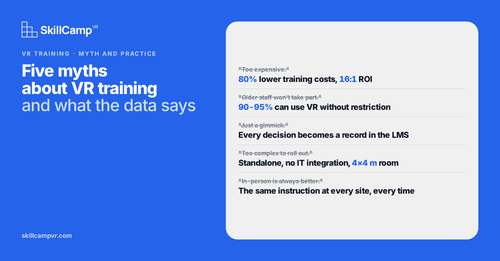
Five Myths About VR Training - and What the Deployment Data Actually Says
Too expensive, too complex, older staff will not take part: five objections to VR training checked against data from live deployments. With sources on cost, usability an
6 septembre 2026 · SkillCamp Redaktion
Lire la suite →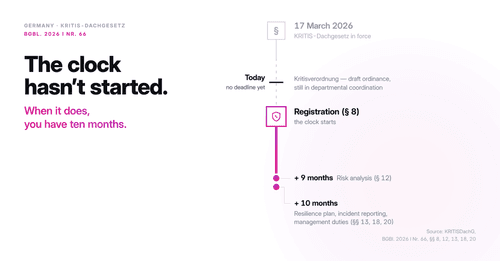
The KRITIS-Dachgesetz: The Personnel Measures Almost Nobody Is Planning For — and Why the Delay Is an Opportunity
The KRITIS-Dachgesetz has been in effect since March 17, 2026, but the ordinance defining critical facilities is still a draft. Registration isn't mandatory yet. Operators should use this valuable planning window now. Once the deadline starts, securing people—not fences—will be the hardest task.
9 août 2026 · SkillCamp Redaktion
Lire la suite →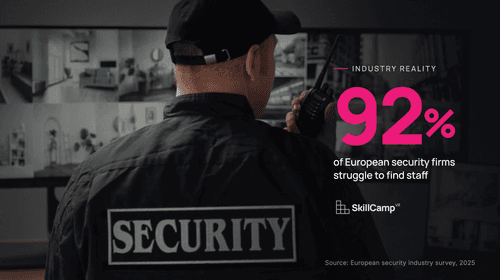
Europe's Private Security Skills Shortage: What the Data Says — and How Training Technology Is Responding
Europe’s private security sector employs around 2 million people and generates over €40 billion a year, yet 92% of firms struggle to recruit. The shortage is structural, not cyclical. This piece explores the data and why training technology is becoming one of the industry’s few practical levers.
27 juillet 2026 · SkillCamp Redaktion
Lire la suite →Bereit, VR-Training in Ihrem Unternehmen einzusetzen?
Sprechen Sie mit unseren Experten und erfahren Sie, wie SkillCampVR Ihre Schulungen transformieren kann.