
Publication · 27 juillet 2026 · 5 min Lesezeit
Europe's Private Security Skills Shortage: What the Data Says — and How Training Technology Is Responding
Europe’s private security sector employs around 2 million people and generates over €40 billion a year, yet 92% of firms struggle to recruit. The shortage is structural, not cyclical. This piece explores the data and why training technology is becoming one of the industry’s few practical levers.
Von SkillCamp Redaktion
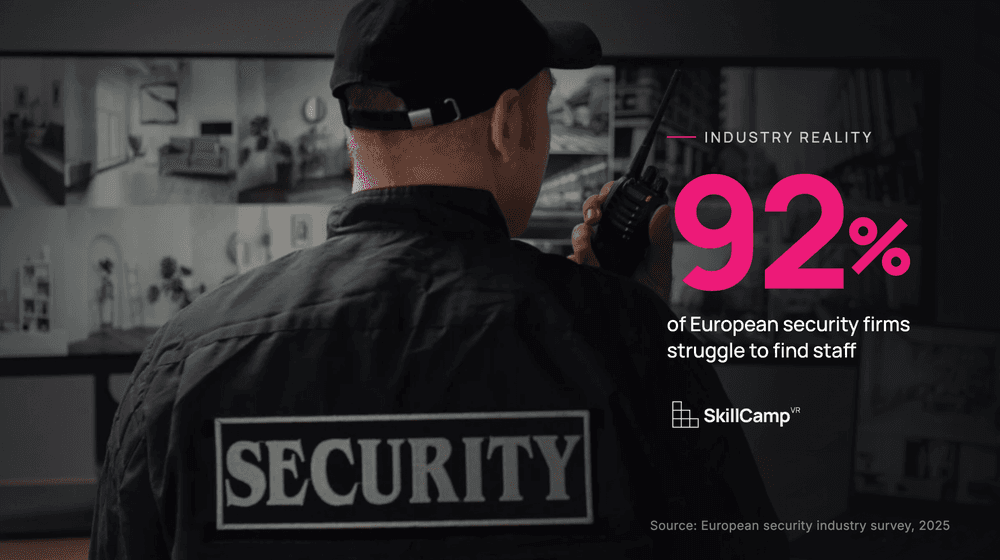
Ask almost any security company in Europe about its biggest operational risk and staffing will be near the top of the list. That intuition is now backed by hard numbers. In the first-ever EU-wide study on labour and skills shortages in private security, conducted for the INTEL project by the Confederation of European Security Services (CoESS) and the trade union federation UNI Europa, 92% of companies reported increasing difficulty finding workers over the past one to five years, and 48% said labour shortages left them unable to fully respond to market demand. This is no longer a hiring inconvenience; it is a limit on how much service the industry can deliver.
A shortage that is structural, not cyclical
The most important finding in the CoESS/UNI Europa research is that the gap is unlikely to close on its own. 70% of sectoral social partners consider future skills shortages significant and likely to persist, and 68% of companies expect labour and skills shortages to be a serious problem for their development over the next five years.
The causes sit on both sides of the market. On the supply side, the sector describes a male-dominated, ageing workforce meeting demographic change, compounded by shortcomings in national education and vocational systems. On the demand side, technological change is creating entirely new service requirements — cyber-physical security, data protection, critical-infrastructure resilience — even as some traditional guarding segments decline. In France alone, the sector's employer body has put the shortfall at roughly 18,000 officers, about 10% of the workforce.
There is also a self-inflicted barrier. **83% of national social partners point to low-cost-focused procurement **practices as a key obstacle to fixing the problem: when contracts are awarded on price alone, there is little room to invest in wages, progression or training — the very things that would attract and retain people.
Why traditional training makes the gap worse
For an industry already short of people, conventional training quietly amplifies the problem. Classroom instruction takes officers off the floor, requires trainers who are themselves scarce, and concentrates learning into one-off sessions after which questions inevitably resurface. Onboarding is slow precisely when speed-to-competence matters most, and knowledge decays fast: retention from traditional classroom training is commonly estimated at just 20–30% a year later.
In other words, the standard response to a staffing crisis — hire and train harder — runs straight into the same capacity constraints that caused the crisis. That is why attention across the sector is shifting toward training methods that reduce time-to-competence and keep knowledge available on the job.
How training technology is responding
Three approaches are converging.
Immersive (VR) training compresses the time it takes to reach competence and lets people practise high-stakes, low-frequency situations — de-escalation, access control, emergency response — safely and repeatedly. PwC's widely cited enterprise study found VR learners complete training up to four times faster than in the classroom, retain far more of it — a**round 80% a year later versus 20–30% **for traditional methods — and report markedly higher confidence to apply what they learned. Independent roundups of enterprise deployments associate VR programmes with 30–50% improvements in retention of staff and meaningful reductions in training time.
**AI assistants grounded in a company's own procedures **address the other half of the problem: what happens after the course. Instead of relying on general-purpose chatbots that don't know local standard operating procedures, officers can query an assistant built on approved, company-specific content — in real time, in multiple languages, on the devices they already use. That keeps standards retrievable during a shift, not just documented in a binder, and eases pressure on scarce trainers and site managers.
**Blended models **tie the two together, so training and day-to-day operations draw on the same reliable knowledge base rather than living in separate worlds.
What to watch next
The regulatory and industry context is moving in parallel. CoESS has published a Charter on the ethical and responsible use of AI in private security, and its social partners have launched a follow-on "INTEL Next Generation" project and a 2026–2028 social-dialogue work programme aimed squarely at labour and skills shortages. The EU AI Act and GDPR also raise the bar for any tool touching frontline staff data — which is why data protection, transparency and human oversight are becoming baseline requirements, not nice-to-haves, for training technology in this sector.
None of this replaces the fundamentals: fair procurement, decent pay and clear career paths remain essential to attracting people into security work. But for the workforce already in place, technology that helps them reach competence faster and act with confidence is one of the few levers available right now. At SkillCampVR, that is the problem we work on — combining VR training with SOP-grounded AI support so that frontline security teams can learn faster and get reliable answers when a situation demands them.
Weitere Artikel
The ROI of VR training: where the money actually comes from
The headset is rarely the cost that matters. Where VR training pays back in practice: shift cover, trainer time, travel, error risk and audit records. With the Securitas figures, an example calculation and the five numbers to collect for your own.
20 septembre 2026 · SkillCamp Redaktion
Lire la suite →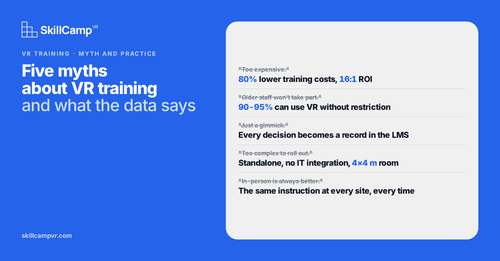
Five Myths About VR Training - and What the Deployment Data Actually Says
Too expensive, too complex, older staff will not take part: five objections to VR training checked against data from live deployments. With sources on cost, usability an
6 septembre 2026 · SkillCamp Redaktion
Lire la suite →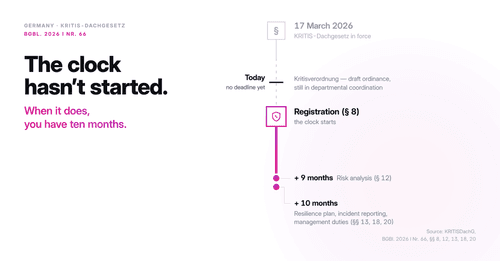
The KRITIS-Dachgesetz: The Personnel Measures Almost Nobody Is Planning For — and Why the Delay Is an Opportunity
The KRITIS-Dachgesetz has been in effect since March 17, 2026, but the ordinance defining critical facilities is still a draft. Registration isn't mandatory yet. Operators should use this valuable planning window now. Once the deadline starts, securing people—not fences—will be the hardest task.
9 août 2026 · SkillCamp Redaktion
Lire la suite →Bereit, VR-Training in Ihrem Unternehmen einzusetzen?
Sprechen Sie mit unseren Experten und erfahren Sie, wie SkillCampVR Ihre Schulungen transformieren kann.